Senior Students’ Experience Sharing
❖ Interview with Mr. Chen 〇-Huang - Outstanding Alumnus of the Ph.D. Program
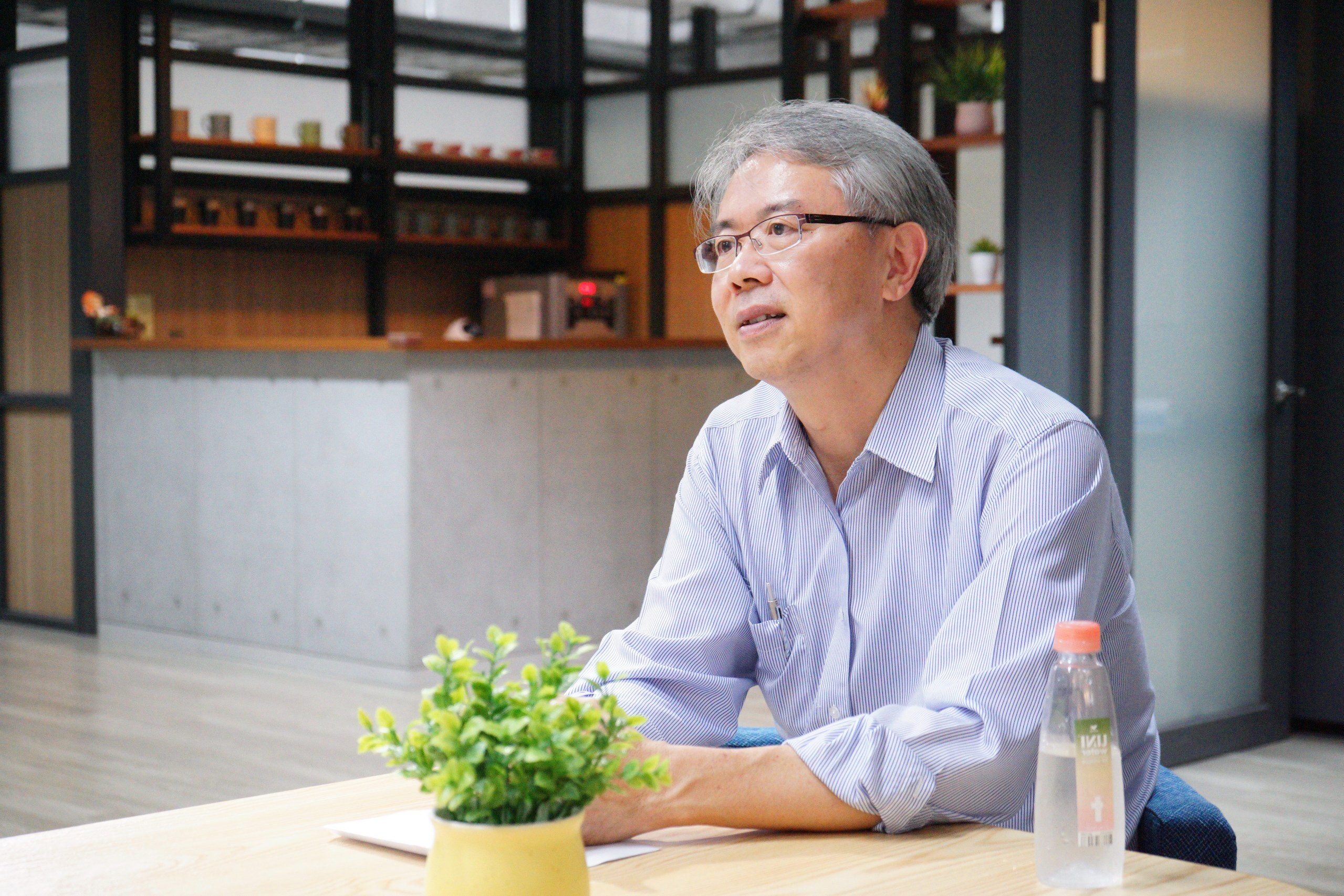
"I discovered that the best things are all abstract, and the greatest thing I gained from the Ph.D. program is intellectual satisfaction."
Mr. Chen 〇-Huang, an outstanding alumnus of the Ph.D. program at the Department of Business Administration, National Chung Cheng University, revealed how fortunate he felt to be able to systematically organize what he had learned through the process of writing his dissertation and book in the Ph.D. program. In addition to earning a degree, it was also a way to account for his life and demonstrate the value of his past work.
During his Ph.D. studies, Mr. Chen believed that the focus was not on "whether you win against others, but whether you have learned." He also shared that we will inevitably hit a wall, so you must be clear about what you want—for example, a degree. In other words, your "motivation" is very important.
Why did you initially choose to enroll in Group B of the Ph.D. Program at the CCU Department of Business Administration?
At that time, after graduating with his master's degree, he pondered what his next methods and channels of learning would be. Thus, for a few years after his master's, he considered whether or not to pursue a Ph.D. However, feeling he wasn't cut out for a purely academic path, he bought books to study on his own—partly to prepare for exams, and partly to confirm if it was truly what he wanted. After a period of doubt and struggle, he happened to see that CCU's curriculum design could integrate practice with academia, and also train him to express his ideas in a systematic way, so he directly applied to study here!
What do you think are the unique features of the curriculum planning in Group B of the CCU Ph.D. Program?
Both the "curriculum planning" and "graduation requirements" were parts he liked very much.
Mr. Chen excitedly said: "The curriculum has two particular advantages: first, you don't need to read a massive amount of literature and papers; second, during the process of organizing your practical experience, the school provides the necessary knowledge and tools (including research methods)."
During the conversation, Mr. Chen specially mentioned that "cultivating humanistic literacy and good values" is a major function of the school. If everyone possesses good literacy today, they can play a leadership role, which has a positive effect on organizations and society.
The relevant courses in the CCU EMBA program are an excellent channel for cultivating humanistic literacy. "Worldly Studies" allows everyone to further see different aspects of life by cultivating aesthetic sense, experiencing humanities and arts, or caring about social phenomena, rather than just focusing on "how to make money." Getting in touch with different fields also helps students understand that the facets of life are actually very broad, expanding their horizons.
During your studies in Group B of the Ph.D. program, what was the biggest challenge for you?
"I think it would be perseverance!" "There were too many tedious things and obstacles to overcome during the study process!" However, the perseverance cultivated at that time has indeed been of great help in his subsequent work, allowing Mr. Chen to face difficult problems with one simple phrase: "Just push through it!"
"Challenges encountered while writing the dissertation?"
Examining whether one's own views or insights "have logic" is a huge challenge, but also the most important one. Consequently, the school provided us with systematic learning and requirements, allowing Mr. Chen not only to train his own discipline but also to express content in an academic manner, successfully transforming practical experience into intellectual value.
During the process of writing your book, what special experiences, challenges, or takeaways did you have?
There is a huge tug-of-war between academic theory and attractiveness.
Although we organized things systematically during the book writing process, whether the organized content "can be understood by the general public" is another challenge. Therefore, Mr. Chen felt that if the theme of the book is something he is interested in, and treated as a personal memento to be gifted to interested readers, it can greatly increase the book's circulation and somewhat reduce the dilemma between theory and attractiveness.
What important knowledge, skills, or abilities do you think a graduate from the Department of Business Administration or MBA program should master before leaving the campus?
(1) Know Yourself
"Knowing yourself is a bitter pill to swallow," Mr. Chen said earnestly.
"Understand what you know, what you don't know, and where the things you do know can be applied." During your studies, you must clearly take stock of what you have learned. When you encounter things you don't know, be brave enough to ask, but also know how to ask questions properly.
The most common doubt encountered when studying business administration is: "We learn so broadly but don't know anything specifically." However, in reality, when facing the workplace, the intangible accumulation of knowledge learned in school will manifest itself. Therefore, Mr. Chen encourages everyone to ask "why" more often; you will definitely be able to find the answers you want!
(2) Learning Interpersonal Interaction in School
Here, Mr. Chen gave the example of Professor Lien Ya-Hui's Organizational Behavior class at CCU. From that class, he learned about observing organizations and human interaction. When you are not the one organizing a meeting, as a team member, you can learn about the trade-offs and conflicts of interest between leading and being led, and even observe the closeness of relationships through interpersonal interactions. Sometimes it is inevitable to encounter boring tasks in organizational work, but you can actually use the downtime to think about the implications of what everyone expresses (e.g., what is the underlying meaning behind a supervisor's words), which can enhance your abilities in the interpersonal domain.
Especially in the field of business management, "people" are the core. If you have the opportunity to engage more in human-to-human interactions, it will be a wonderful thing.
In conclusion, a "learning attitude" is very important; regardless of whether your grades are good or bad, a good learning attitude is essential. Furthermore, "humanistic literacy" is an indispensable element in the realm of leadership and management! We can cultivate humanistic knowledge through school courses to strengthen our own leadership abilities.
Finally, Mr. Chen advised his juniors who are still studying: "Besides learning humbly, having self-confidence is also very important. You will encounter many dilemmas along the way, but you will definitely grow through the struggles. You must also have discipline when learning, and school is an excellent place to cultivate discipline."